
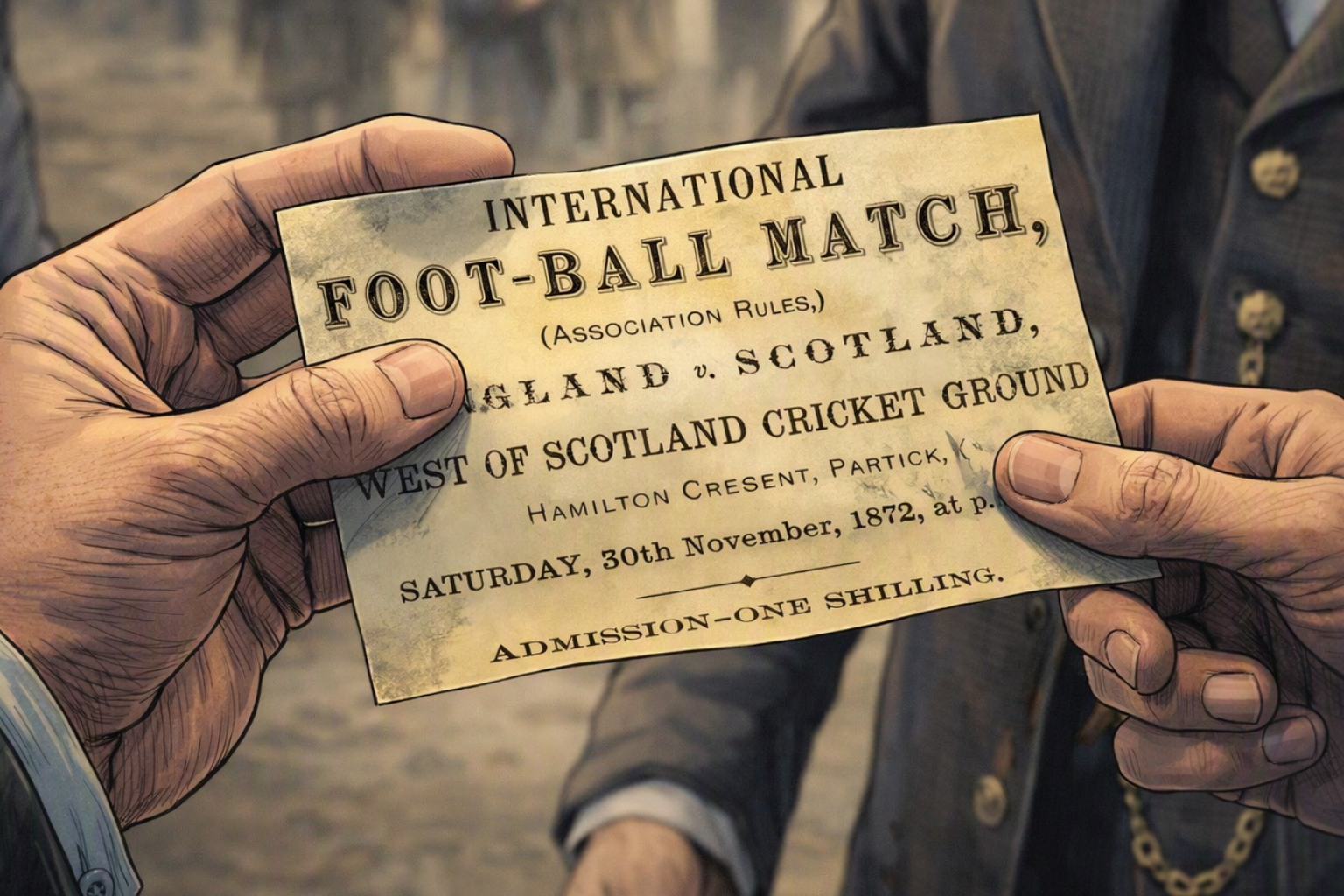
It began on a cold November afternoon in Glasgow in 1872, when Scotland and England faced each other in what would become the first official international football match. The game finished goalless, yet its impact was seismic.
From that moment, football ceased to be a local pastime and became a contest between nations—a stage for pride, identity, and rivalry. Every player who has since worn their country’s colours, and every fan who has followed their team across continents, traces their story back to those twenty‑two pioneers who stepped onto the field and unknowingly launched the global game.

I. In The Beginning: Morley’s Rules
Football’s early development was in England’s public schools and gentlemanly clubs, but the sport soon required a governing structure that reached beyond it’s borders. That turning point arrived in 1886, when the football associations of England, Scotland, Ireland, and Wales came together to form the International Football Association Board (IFAB) – a body created to define, preserve, and periodically revise the Laws of the Game.
By committing to the foundational laws first drafted by the Football Association in 1863, the four Home Nations ensured that the sport would be played under a unified charter, eliminating the confusion caused by competing regional variations. Those rules were decided on 26 October 1863, when representatives from eleven London clubs and schools gathered at the Freemasons’ Tavern, Covent Garden in London. Under the guidance of Ebenezer Cobb Morley, the group established the Football Association (The FA), creating a formal body to regulate how the game should be played.
Morley was a true Victorian sportsman. After settling in Barnes in South West London, he joined the London Rowing Club, and it was with fellow oarsmen that he founded Barnes Football Club. His nonconformist upbringing and schooling shaped his belief that football needed structure, and he argued publicly that the sport should adopt formal rules just as cricket had. His call led the congregation at Freemasons’ Tavern and the FA was born.
Prior to the meeting, Morley drafted thirteen laws at his home in Barnes. They reveal just how dangerous the game once was as Law 13 banned players from wearing projecting nails or iron plates on their boots. It was no surprise that Morley became the FA’s first Honorary Secretary, serving from 1863 to 1866, before later acting as its second president. He even scored the opening goal in the London vs. Sheffield representative match in 1866 and, in 1872, became the first man to present the FA Cup to the winning team, Wanderers F.C.
Back to Freemasons’ Tavern, a decisive moment came when the assembly voted to outlaw hacking and the carrying of the ball—two practices central to the rougher, handling‑based versions of the sport. That vote created a permanent divide. Clubs that preferred the more physical, hand‑driven style eventually broke away to form the Rugby Football Union in 1871, while the FA’s original thirteen laws became the foundation of association football.

II. The “First” Match
Come 30 November 1872 at around 2:15 pm, the first official international football match was organised as England travelled to Scotland, up at the West of Scotland Cricket Ground, Hamilton Crescent, in Partick, Glasgow. Fittingly on St Andrew’s Day, this date is now celebrated as Scotland’s national day. Although football had already been developing rapidly across Britain, this fixture would mark the moment the sport stepped beyond local and school‑based traditions and into the territory of what would be international competition.
In the nineteenth century, Glasgow was transforming rapidly. Industrialisation reshaped what had once been a modest town of 70,000 into a major global port and manufacturing hub, home to more than half a million people by 1872. Shipyards, cotton mills, and engineering works dominated the banks of the River Clyde, earning the city its reputation as the British Empire’s second city after London. Yet this rapid growth came with deep social challenges. Neighbourhoods such as the Gorbals became overcrowded, foreshadowing the stark inequalities that would define parts of Glasgow for generations.
Ironically, this same area would end up hosting three of the largest football stadiums in the world—Hampden Park, Ibrox, and Parkhead—each capable of holding more than 100,000 spectators and becoming iconic venues. With none of Glasgow’s great stadiums yet built in 1872, this match was instead played in the affluent burgh of Partick. At the time, Partick was a separate town just west of central Glasgow, and the West of Scotland Cricket Ground provided an unlikely but fitting stage for a fixture.
In the years leading up to the match, five earlier representation games had been staged in London between 1870 and 1872. These were not recognised as true international matches, as the Scottish sides were composed largely of London‑based players selected by invitation rather than by nationality. The 1872 encounter was different. It was sparked by a public challenge issued by Charles Alcock, Secretary of the English FA, in the Glasgow and Edinburgh newspapers.
With no Scottish football association yet in existence, Queen’s Park supplied all eleven players for the Scotland team. Two trial matches were held after club president Archibald Rae announced the fixture and appealed for volunteers. The initial squad included three rugby internationals and the London‑based Arthur Kinnaird, but these men were ultimately excluded. Queen’s Park insisted that, since their reputation was at stake, only their players should represent the nation.
Robert Gardner, a founding member of Queen’s Park, captained and selected the team. He played the first half in goal before switching positions with Robert Smith and moving into the forward line. Smith and his brother James were playing for West Norwood in London at the time, but both retained their Queen’s Park membership and declared eligible to take part.
Also among the Scottish XI, Billy MacKinnon emerged as Scotland’s first great international footballer. Born in 1852 on Eglington Street in the Gorbals, where his only club, Queen’s Park, would be founded fifteen years later, MacKinnon became a central figure in the early England–Scotland fixtures. By the end of the 1870s he was the world’s most‑capped player, making nine appearances, and the leading scorer with five goals. He scored four times against England and added another goal against Wales on 25 March 1876 in a Scottish 4–0 victory.
MacKinnon played in all of the first seven internationals against England and lived to the age of ninety, passing away in 1942, making him the longest‑lived participant from the historic 1872 match.
England’s team saw representative’s from Notts County, Oxford and Cambridge University, Crystal Palace, Sheffield Wednesday, Harrow Cheuqers, Hertfordshire Rangers, the 1st Surrey Rifles and Morley’s Barnes Football Club. The players endured a long and exhausting journey. Seven travelled on the morning train from London Euston on 29 November, while the rest followed that evening, arriving on the morning of the match. The Caledonian mainline allowed for a direct route, but the trip still took twelve and a half hours—far from ideal preparation for an international contest. The advance party stayed at Carrick’s Royal Hotel on George Square, where they were joined by their teammates the next day.
The goalmouth looked nothing like it would today: two upright posts with a tape stretched eight feet above the ground marked the target, and nets were still years away. The kits, however, would be familiar. Scotland played in Queen’s Park’s dark blue, each shirt adorned with a white lion rampant hand‑stitched by Marion Wotherspoon, sister of David Wotherspoon. England wore plain white shirts featuring three navy lions.
It was reported in the newspapers that 4,000 spectators attended, paying one shilling for admission, while women could watch for free. However the FIFA Museum records a crowd closer of 2,500. Regardless of the true attendance, they reportedly waited through a twenty‑minute delay before settling in to watch a contest played in the relaxed, good‑natured atmosphere that would define England–Scotland meetings for more than a century, and the match was played in a remarkably friendly spirit, leaving the Scottish referee, Mr. William Keay, with few difficult decisions.
The heavy pitch, soaked by three days of Glasgow rain, suited the lighter Scottish side, who pushed England hard throughout. Any advantage Scotland might have gained from fielding an entire Queen’s Park team was balanced by how quickly the English players gelled, easing fears that their unfamiliarity would hinder them.
England’s Robert Barker was less rigid in his role, swapping positions with William Maynard to play outfield. In an era when teams routinely fielded six or seven forwards, Gardner’s choices almost paid off. Late in the game, Scotland’s Robert Leckie sent a shot onto the tape strung between the posts to serve as a crossbar, coming as close as either side would get to breaking the deadlock.
The crowd witnessed history but not a goal. It demonstrated football’s potential as a spectator sport and established the template for international competition. From this modest beginning in Glasgow, the global story of international football began to unfold. That encounter helped propel the game beyond Britain, inspiring the creation of FIFA in 1904 and laying the groundwork for the inaugural World Cup in 1930. From a meeting in a London boozer, football’s evolution into an international phenomenon was already well underway.

III. The Birth of FIFA and The Olympic Games
Adopting the IFAB’s laws, the creation of Fédération Internationale de Football Association (FIFA) occurred in 1904. From that point on, any major change to the laws of the game would be determined not by FIFA itself but by IFAB. That structure is still live today, giving IFAB a unique and lasting authority over the sport’s rules and cementing its place as one of the most influential institutions in world football.
During these early years, one of FIFA’s founders, Jules Rimet played a defining role in shaping the organisation’s character. To him, football was far more than a game—it had the power to promote peace. He rejected rigid amateurism as the “antisocial pretension of a privileged oligarchy,” and championed a more open, global competition that welcomed players from every background.
FIFA was founded in Paris on 21 May, after the success of the early international matches and the game’s expansion across Europe proved football’s potential as a universal language, and created an urgent need for structure and coordination. A central authority was required to oversee this growth, regulate international fixtures, and ensure that matches were played under the unified set of rules.
The initial agreement brought together seven countries: France, Belgium, Denmark, Spain, Sweden, Switzerland, and the Netherlands. One of the most notable absentees was the nations of the United Kingdom, despite being the birthplace of modern football. Robert Guérin, a young French journalist, became FIFA’s first president.
Apparently France initially opposed England’s entry, insisting on a strict “one nation, one federation” rule but there is conflicting information about this. Guérin stated in later years that he was surprised that England—where football was flourishing—had not taken the initiative to join FIFA. Believing the chairmanship should naturally belong to the English FA, he travelled to London to meet Frederick Wall, then the FA secretary. Wall promised only to consult the board, but months passed with no reply. When Guérin pressed again, he was invited back to London and met Lord Kinnaird, who was cordial yet non‑committal.
Frustrated by England’s hesitation, the 28‑year‑old Frenchman decided to act alone. He convened the meeting that founded FIFA and althought reluctant to assume leadership, Guérin accepted the presidency and guided the fledgling body for two years until Englishman Daniel Woolfall succeeded him in 1906.
England would be eventually admitted in 1906, and four years later FIFA made an exceptional ruling that allowed Scotland, Wales, and Ireland to join separately. This preserved each nation’s long‑standing tradition of playing international football independently. What began as a small European initiative soon grew into the governing body of the world’s most popular sport, laying the foundations for international competition as it exists today.
Meanwhile prior to FIFA’s inception, football in the Olympic Games evolved quickly in the early twentieth century. Although claims persist of an informal tournament at the first modern Olympics in Athens in 1896, the sport’s official Olympic debut came four years later at the 1900 Paris Games. In these early editions, the competition bore little resemblance to the international tournaments that would follow.
Rather than national teams, club sides represented their countries. Great Britain’s Upton Park Football Club won the first gold medal, defeating Club Français (representing France) and Université de Bruxelles (a team of Belgian students). The 1904 St. Louis Games continued this pattern, with Galt FC (of Canada) overcoming two American sides (St. Rose Parish and Christian Brothers Cadets) to claim gold.
A major shift came in 1908 when FIFA began supervising and formally recognising Olympic football as an international knockout competition. The London Games featured six teams—rather than the planned eight, after Hungary and Bohemia withdrew for financial reasons—and Great Britain, represented by its national amateur side under strict amateur rules, won the gold by defeating Denmark 2–0 before 10,000 spectators at the White City Stadium. The tournament also produced some extraordinary early‑round score lines, with Britain beating Sweden 12–1 and Denmark overwhelming France 17–1, highlighting both the uneven development of the sport across the globe.
Four years later, at the 1912 Stockholm Games, the field expanded to eleven teams. Great Britain again triumphed. Hosts Sweden exited in the opening match after a narrow 4–3 extra‑time loss to the Netherlands, while Finland beat Italy, also in extra time. Finland then defeated Russia in the second round before meeting Great Britain, who entered the tournament at this stage.
Captained by Vivian Woodward and inspired by Harold Walden’s six goals, Britain swept aside Hungary 7–0. Walden scored all four goals in a 4–0 semi‑final win over Finland, while Denmark beat the Netherlands 4–1 in the other semi. The final paired Britain and Denmark for the second Olympics in succession, with the Brits again taking gold, though Denmark played most of the match with ten men after Charles Buchwald was injured.
The interruption of World War I halted Olympic football, but the sport returned in 1920 at the Antwerp Games with a new sense of purpose. Egypt became the first non‑European nation to participate, signalling the beginning of football’s global reach. Belgium won the gold medal in a final overshadowed by controversy, when the final was abandoned in the 39th minute – the only international final ever to be abandoned.
Belgium led 2–0 when Czechoslovakia walked off in the 39th minute after left‑back Karel Steiner was sent off for assaulting Robert Coppée. The Czechoslovaks were already furious with the officiating of 65‑year‑old English referee John Lewis and his linesmen, Charles Wreford‑Brown and Arthur Knight, who had allowed a disputed second Belgian goal. All three officials had overseen Belgium’s semi‑final two days earlier, a match the Czechoslovaks had watched from the stands. Their protest was immediately rejected, and the team was expelled from the tournament, leaving Belgium with the gold.
The Antwerp tournament marked a clear turning point: Olympic football was no longer a purely European affair, and the true transformation came in the 1924 and 1928 tournaments, held in Paris and Amsterdam. For the first time, FIFA recognised both events as world championships for amateurs. These tournaments highlighted South America’s emergence as a footballing force and showed how far the game had travelled from its British roots.

IV. The British Influence in South America
Football first reached the continent through British immigrant workers, traders, and railway managers in the nineteenth century, who introduced the sport while overseeing industrial projects. Amazingly by 1867, the laws created in the Freemasons Tavern four years earlier, found their way to South America. In Argentina, British railway employees founded the Buenos Aires Football Club, South America’s first team, the first non‑European team of its kind, while in Brazil the game spread around the docks where British labourers played.
These expatriate communities established clubs that followed the recently codified laws, and the sport quickly gained popularity among local populations. Football was easy to pick up. It required little more than a ball and an open space and its simplicity allowed it to flourish rapidly, embedding itself in South American culture long before the region emerged as a global powerhouse.
Buenos Aires had a surge of British immigrants by 1867, largely made up of employees of British‑owned railway companies operating across the country. Their presence created the social and industrial networks through which football first took root. Around 40,000 Britons lived in Buenos Aires by 1880, the largest British community outside the Empire. Their influence helped formalise the sport, and in 1891, with Scottish immigrant Alec Lamont’s support, representatives from five clubs—Buenos Aires and Rosario Railways, Buenos Aires Football Club, Old Caledonians, St. Andrews Scotch Athletic Club and Belgrano—founded the Argentine Association Football League.
Yorkshireman Thomas Hogg played in Argentina’s first recorded football match and, alongside his brother James, helped establish the Buenos Aires side. Determined to embed the sport in the country, he told The Standard with characteristic resolve:
“This game will take a long time to spread even among British residents, but I intend to persist, because I consider it the best, easiest and cheapest pastime for middle‑class youth, as well as for the common people”.
The sport’s development accelerated under Scotsman Alexander Watson Hutton, who taught football at several schools and founded the Buenos Aires English High School in 1884. From this institution emerged Alumni Athletic Club, the dominant side of the era and widely regarded as Argentina’s first great team. Although they dissolved in 1913, Alumni’s 22 titles still place them among the most successful clubs in the nation’s history.
In Brazil, Charles Miller is widely regarded as the father of football in the country. He was the son of Scotsman John Miller, a railway engineer living in São Paulo. Charles, was born in Brazil and then sent to Southampton for his education at the age of ten, and ended up playing County football for Hampshire before returning to Brazil in October 1894. He brought with him two footballs and a copy of the rules. His arrival sparked organised play, including a landmark match on 14 April 1895 between the São Paulo Railway Company and the Gas Company. Miller went on to help establish São Paulo Athletic Club (SPAC), co‑found the Liga Paulista, win three league titles as a player, and serve as a respected referee and administrator, laying the foundations of the Brazilian game.
Another railway worker, John Harley, born in Glasgow in 1886, took on a job as a draughtsman in 1906 on new lines along the Río de la Plata. He played for several railway teams in Argentina before catching the eye of Central Uruguay Railway Cricket Club (who became Peñarol) during friendlies in 1908. Uruguayan observers hailed him as the best player on the pitch, and Peñarol quickly recruited him, offering work with the railway to secure his signature.
Harley, fully settled in Montevideo, captained the team. His calm, positional style reshaped the club’s approach and, eventually, Uruguay’s. As player‑manager of the national team from 1909 to 1916, he helped forge the controlled, collective game that would carry Uruguay to Olympic glory in the 1924 and 1928, then later, World Cup triumphs in 1930 and 1950.
However, the country’s football’s beginnings trace back to the founding of Montevideo Cricket Club in 1861, the country’s first—and still oldest—sports institution, predating what is generally regarded as the first match in 1878. That early game in La Blanqueada was described as “almost like rugby,” and the sport remained unruly for years. By the turn of the century Uruguay had its first stadium in Paso Molino, along with a governing body and organised league. The national team’s debut was a heavy 6–0 defeat to Argentina in 1902, but Uruguay’s rise would be swift and transformative.
Their arrival in the 1924 Olympic Games was nothing short of revolutionary. The first South American nation to enter the Olympic tournament, they stunned European audiences with a fast, fluid style of combination play that contrasted sharply with the more rigid European approach. They swept through the tournament and beat Switzerland 3–0 in the final, earning admiration for their technical skill and inventive tactics. Even so, Uruguay’s game still carried a notable physical edge during this period of transition.
Four years later, Uruguay returned to defend their crown, beating fellow South Americans Argentina in a dramatic final to secure back‑to‑back gold medals. Their dominance transformed global perceptions of the sport, proving that football’s future would not be shaped solely in Europe and that new styles, ideas and footballing cultures were beginning to redefine the game.
Their achievements also had lasting consequences: in recognition of their Olympic triumphs, FIFA awarded Uruguay hosting rights for the first World Cup in 1930. The Olympic tournaments of 1924 and 1928 thus served as the bridge between football’s amateur past and its professional future, laying the foundations for the global competitions that would follow.
V. The Future under FIFA
When delegates from seven European nations gathered in Paris on 21 May 1904 to form the Fédération Internationale de Football Association, few could have imagined how rapidly the international game would expand—or how profoundly it would reshape global sport. Within two years, FIFA opened its first office in Amsterdam, signalling its intention to operate as a structured, permanent institution rather than a loose coalition of associations.
Membership grew steadily. South Africa joined in 1910, becoming the first African nation to enter the fold. Argentina and Chile followed soon after, joining in 1912 and 1913 respectively, and becoming the pioneers of South American involvement. Their arrival was significant: football was already flourishing there and the continent’s passion for the sport would soon become one of the organisations’ driving forces.
By the outbreak of the First World War in 1914, FIFA had grown to 24 members, including Canada and the United States of America. The war halted international competition, but the organisation survived, and its post‑war revival would prove transformative. The 1920s were the decade in which FIFA’s global ambitions crystallised. As football spread across continents, the organisation began to formalise the structures needed to govern an increasingly international game.
In 1924, FIFA compiled its first official list of international referees—34 officials from nine countries deemed capable of overseeing matches between national teams. It was a small administrative step, but symbolically important: international football was becoming regulated.
Asia entered the picture around the same time. The Dutch East Indies association became the continent’s first representative, though it later withdrew, leaving Thailand, who joined in 1925, as Asia’s longest‑serving member. The sport’s reach was now unmistakably global.
Yet the most significant development of the decade came in 1928 at the 17th FIFA Congress in Amsterdam. Delegates approved the creation of a new tournament: a world championship for national teams. The idea had been discussed for years, fuelled by the success of Olympic football competitions and the growing desire for a standalone global event. Now, the dream had a name—the FIFA World Cup.
What began as a small European organisation had become a global governing body overseeing a sport played and loved across continents. The World Cup provided a stage on which nations could compete, celebrate, and express their footballing identity.
The foundations laid between 1904 and 1930—expanding membership, unifying rules, professionalising refereeing, and launching a world championship—created the framework for the modern game. Football’s future was no longer confined to Europe’s playing fields or South America’s passionate clubs. It was international, ambitious, and ready to grow.
The world had embraced football. And FIFA had finally embraced the world.
Next Week: Part One of the History of World Cup Series – The 1930 Uruguay World Cup
Will Burns
Follow us on Twitter at @TheIntlBreak
Please gamble responsibly. BeGambleAware.org