
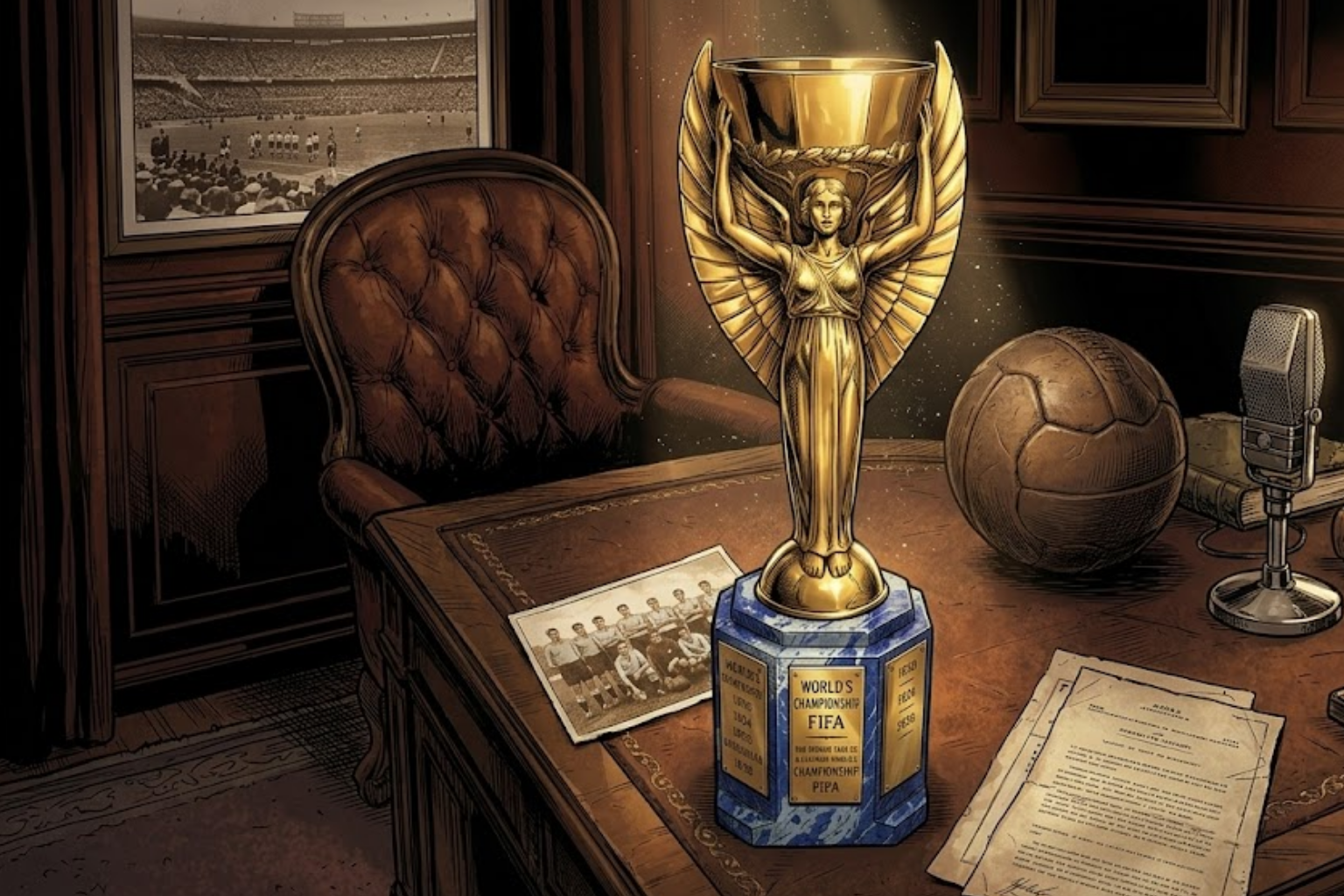
The year 1930 marked a monumental milestone in sports history with the first-ever World Cup tournament taking place in Uruguay. While today the World Cup is a global spectacle drawing billions of viewers, its inception was a dramatic, hard-fought affair characterised by political mandates, European boycotts, intense South American rivalries, and unique logistical anomalies.
By the 1920s, football had outgrown its amateur roots. A growing divide emerged between the Olympic ideal of pure amateurism and the surge of professionalism sweeping through countries such as England, Italy, and Austria. With the Olympics excluding professional players, many of the world’s finest talents were left watching from home — a situation that underscored the urgent need for a fully professional international tournament.
The vision for this era belonged to Jules Rimet, the president of FIFA, who believed football could serve as a universal language to unite a world devastated by World War I. As the decade closed, the search for a host led to a socio-political landscape defined by economic fragility and intense national pride.

I. FIFA’s Big Idea
On 21 May 1904, three delegates — Cornelis August Wilhelm Hirschman of the Netherlands, Victor Schneider of Switzerland, and Ludvig Sylow of Denmark — met in the modest office of French lawyer Robert Guérin. Guérin had invited eight representatives from clubs belonging to six nations to witness the establishment of a new governing body: Fédération Internationale de Football Association (FIFA).
The organisation’s beginnings were far more modest than those of the International Olympic Committee (IOC) who serves as the worldwide, non‑governmental authority that governs the modern Olympic Games. The IOC had united six countries a decade earlier to launch the Olympic movement, yet the founders recognised that football was rapidly becoming one of the most important Olympic sports, and unlike many other disciplines, it already had a strong British heritage and a long tradition of organised play.
By the time FIFA was created, football already had deep roots with the English Football Association formed in 1863, followed by Scotland in 1873, Wales in 1876, and lastly Ireland in 1880. England–Scotland fixtures had become established events, and with the exception of Italy, FIFA’s earliest members all possessed well‑developed football cultures.
Guérin’s connections with amateur clubs and leagues proved valuable, and founding the organisation in France was a diplomatic move: although Britain had shaped the sport, France was the first nation outside the British Isles to take a leading role in its international development. Belgium, the Netherlands, and Switzerland soon followed.
At FIFA’s first official meeting in August 1904, the delegates agreed that the organisation would abide by the laws set by the International Football Association Board (IFAB). From that moment onward, responsibility for any major alteration to the Laws of the Game rested not with FIFA but with IFAB — a structure that still exists today and gives IFAB enduring authority over football’s rules, making it one of the sport’s most influential institutions.
The delegates also chose to formally recognise the English Football Association (The FA) as FIFA’s representative from Britain, acknowledging its long-established tradition of international fixtures. FA president Lord Arthur Kinnaird sent Robert Guérin a letter of congratulations to mark the occasion.
However, cooperation between FIFA and the International Olympic Committee soon proved problematic. The IOC could offer little beyond a handful of European tournaments, and the first attempts at joint planning produced no meaningful progress.
In FIFA’s second meeting, held in Paris in 1905, brought together the same four delegates: Schneider (Switzerland), Hirschman (Netherlands), Sylow (Denmark), and Guérin (France). They agreed to stage a world championship in 1906, with an agreement that Switzerland would organise and host the tournament and Germany, Belgium, and the Netherlands would participate.
However, the championship collapsed before it began. Interest was minimal, and the FA refused to take part. As the only association with extensive international experience, England’s absence proved fatal. For decades, the British Home Championship — the annual contest between England, Scotland, Wales, and Ireland — had been regarded as the true summit of international football, the only tournament that mattered and the definitive test of supremacy.
To British administrators, this four‑nation rivalry was far more prestigious than anything FIFA was trying to build, and foreign teams were viewed as technically inferior and too distant to justify involvement. England, the only association with extensive international experience, refused to take part in a tournament it did not control, and without the FA’s participation the event simply could not proceed.
Their belief that the Home Championship was the proper challenge combined with a reluctance to join a new international body that might dilute their influence or require long, expensive travel for what they dismissed as a new‑fangled competition, ensured the 1906 World Cup never got off the ground.
II. FIFA’s Struggles
Association Football had already featured in the Olympic Games, and the sport developed rapidly in the early twentieth century. An outlaw competition, non-FIFA recognised (as it didn’t exist) took place at the 1896 Athens Olympics, the sport made its official debut at the 1900 Paris Games, where club sides rather than national teams represented their countries.
Great Britain’s Upton Park won the first gold medal by defeating Club Français of France and Université de Bruxelles, a Belgian student team, and the 1904 St. Louis Games followed the same pattern, with Canada’s Galt FC beating two American teams to take gold. A decisive change arrived in 1908 when FIFA began supervising and formally recognising Olympic football as an international knockout tournament.
The early Olympic tournaments were contested exclusively by amateur sides, reflecting the sporting values of the time. The first recognised tournament, again at the Olympics, was played entirely by amateur teams, reinforcing the idea that international football should be rooted in amateur participation. This emphasis on amateur status shaped the sport’s early development and influenced FIFA’s approach to organising global competitions in the years that followed.
In the years following its creation, FIFA struggled to establish itself as a stable governing body. The organisation lacked strong leadership, clear direction, and reliable participation from its member associations. Many national federations were hesitant to commit to international competitions, and disagreements over rules, authority, and amateur status repeatedly stalled progress.
The Olympics offered a temporary solution, providing a structured environment where international matches could take place. Yet even these events exposed FIFA’s weaknesses. The organisation had little influence over the Olympic programme, and its attempts to assert control often clashed with the IOC’s priorities. As a result, FIFA found itself in a precarious position, unable to fully govern the sport it claimed to represent.
Despite these difficulties, football’s popularity continued to grow. Crowds flocked to matches, and nations increasingly recognised the value of international competition. The demand for a properly organised world championship became impossible to ignore — and FIFA needed to evolve if it hoped to survive.
III. The end of Amateurism
In 1914, FIFA formally recognised the Olympic football tournament as a “world championship for amateurs,” but as the sport embraced professionalism in certain countries, the Olympic model had became increasingly untenable. The strict amateur‑only rules barred many of the world’s best players from competing, exposing a widening gap between the sport’s evolution and the structures meant to govern it.
World War I began also in 1914 and brought FIFA’s early ambitions to a sudden halt, fracturing football governance. Deep political tensions spilled into the organisation, most notably when the British associations demanded the expulsion of Germany, Austria, and Hungary because of their roles in the conflict. When FIFA refused, the Home Nations withdrew entirely in 1920, creating the first major diplomatic rift in international football.
At the same time, the devastation of the Great War shaped the philosophy of FIFA’s new president, Jules Rimet. Elected in 1921, Rimet was inspired by the optimism of the Roaring Twenties and believed passionately in sport’s ability to heal and unite. He saw football capable of fostering understanding between nations emerging from the horrors of conflict. The push for the tournament was driven by him and Henri Delaunay, secretary of the French Football Association.
Uruguay’s emergence as a football powerhouse transformed the international landscape. Their triumphs at the 1924 and 1928 Olympic Games showcased a level of skill, athleticism, and tactical sophistication that astonished spectators across Europe. The Uruguayans played with a fluidity and confidence that set them apart from their rivals, earning admiration and respect wherever they competed.
Their performances demonstrated that football had moved beyond its British origins and was becoming a truly global sport. Uruguay’s success also highlighted the limitations of the Olympic amateur system as many of the world’s best players were no longer amateurs, and the strict rules governing Olympic participation prevented the strongest teams from competing on equal terms.
The brilliance of Uruguay’s Olympic campaigns helped convince FIFA that the sport needed a dedicated world championship — one free from the constraints of amateurism and capable of attracting the best players from every continent and as football developed, the line between amateur and professional players became increasingly blurred.
Many athletes officially registered as amateurs were, in reality, receiving payments, benefits, or indirect compensation for their participation. This phenomenon, which is often referred to as “shamateurism”, created tension within the sport.
Shamateurism, a blend of “sham” and “amateur,” refers to the long‑standing practice in which athletes officially competed as unpaid amateurs while secretly receiving money or valuable benefits. Rooted in 19th‑century elite sporting culture designed to exclude working‑class competitors, it appeared in many forms: Olympic “broken‑time” payments that allowed athletes to train full‑time through military or civil‑service jobs, covert wage compensation, and the “boot money” tradition in English football and rugby, where players were quietly paid through hidden cash, inflated travel expenses, sponsorship deals, or no‑show jobs. Its widespread use eventually forced governing bodies to abandon strict amateur rules.
Some nations clung to the ideal of amateur purity, insisting that professionalism undermined football’s spirit. Others recognised that the sport had evolved and that players deserved proper compensation. The Olympic tournaments became battlegrounds for these debates, with accusations of disguised professionalism frequently directed at successful teams.
The persistence of shamateurism made it clear that the amateur model was no longer sustainable. Football needed a system that acknowledged the realities of the modern game — and that system would eventually be built around professionalism. But the rise of professional football reshaped the sport’s future. Professional leagues attracted larger crowds, generated more revenue, and produced higher levels of play. Players trained more rigorously, clubs invested in better facilities, and tactical innovation accelerated. The professional game quickly outpaced amateur football in both quality and popularity.
FIFA gradually accepted that professionalism was essential for the sport’s growth. The organisation began adapting its rules and competitions to accommodate professional players, paving the way for a fully global championship. This shift marked a turning point: international football would no longer be limited by amateur restrictions, and the world’s best players could finally compete on the same stage.

IV. The Need for a Global Tournament
The transition from amateur ideals to professional reality laid the foundation for the modern World Cup. It allowed nations to field their strongest teams, encouraged the development of national leagues, and ensured that football could flourish as both a sport and a spectacle.
Dutchman C.W.A. Hirschman (known as Carl) played a pivotal role in shaping the early international structure of football. An administrator with a deep commitment to sport, he became one of the most influential figures in FIFA’s formative years. Hirschman worked tirelessly to strengthen the organisation, helping it navigate periods of instability and guiding it toward a more coherent identity.
He also maintained close ties with the Olympic movement, recognising that football’s future depended on cooperation between FIFA and the IOC. Hirschman’s diplomatic skill and organisational vision made him a central figure in the effort to establish football as a truly global game. His contributions laid essential groundwork for the creation of an independent world championship.
This movement gained momentum throughout the 1920s, driven by administrators like Hirschman, Rimet and Delaunay who understood that football required its own global stage. Their efforts culminated in the creation of the World Cup — a competition that would transform the sport and redefine international football.
Next Week: Part One of the History of World Cup Series – The 1930 Uruguay World Cup
Will Burns
Follow us on Twitter at @TheIntlBreak
Please gamble responsibly. BeGambleAware.org